
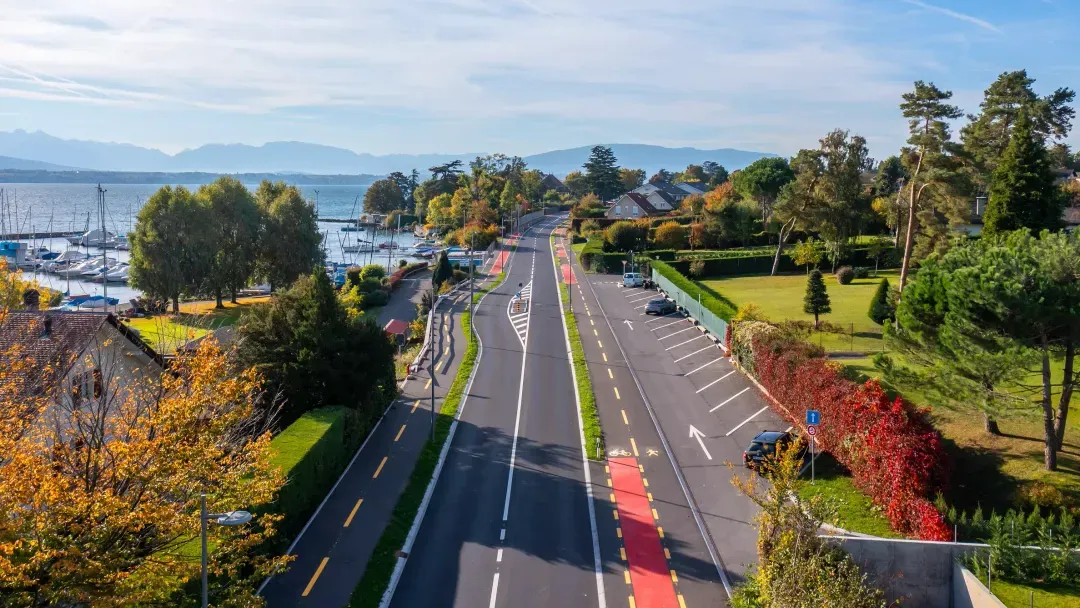
Modern traffic surfaces must meet requirements for safety, visibility, skid resistance, durability, and proper execution. This is not covered by a single standard. The design and implementation of horizontal road markings and safety surfaces rely on a combination of legal regulations, Czech technical standards, technical conditions of the Ministry of Transport, and the requirements of the specific road authority.
For horizontal road markings, the most important is ČSN EN 1436 – Road marking materials – Road marking performance for road users, which sets out requirements for the functional properties of markings. In practice, TP 133 – Principles for horizontal road markings on roads and other technical regulations are also applied depending on the specific application.
One of the important parameters of horizontal road markings is their visibility under various weather conditions. From this perspective, a distinction is made between Type I and Type II markings.
Type I represents standard horizontal markings, whose functional properties are assessed primarily under dry conditions. In the rain, a continuous film of water can form on its surface, which limits light reflection and thus reduces the visibility of the markings for drivers.
Type II is intended for situations where better visibility is also required in wet and rainy conditions. The design and structure of the markings make it possible to limit the effect of the water film on retroreflection, so the markings remain more legible even in adverse conditions.
This is the principle behind WeTraffic 497, which is designed for Type II horizontal road markings. Its structured surface is created by roller application and resembles the structure of agglomerated markings. In addition to high skid resistance, it also improves the visibility of the markings in wet conditions.
This is important, for example, for traffic lanes, pedestrian crossings, directional arrows, or other horizontal road marking elements, where it is necessary to combine long-term durability, visibility, and safe tire-to-surface contact.
More about WeTraffic horizontal markings

Color highlighting in itself does not replace prescribed horizontal or vertical road signs. Pedestrian crossing must be marked in the manner prescribed by the relevant regulations. The primary legal regulation in this case is Decree No. 294/2015 Coll., which governs the design and meaning of traffic signs.
Colored surfacing can be used as a safety and visual element, which alerts drivers to areas with increased risk – for example, before a pedestrian crossing, in an intersection, on a cycling route, or at other conflict points. However, the specific solution must be designed in accordance with local traffic regulations and relevant technical standards.
Color highlighting is therefore not just a matter of aesthetics. In combination with a suitable anti-skid texture, it can help visually define a high-risk area while simultaneously increasing traffic safety.
Regarding high-friction surfacing, it is important to distinguish between legal obligations and technical requirements. The law does not generally mandate that HFS must be installed on every road or at every pedestrian crossing. The use of high-friction surfacing is primarily based on an assessment of the specific location and the requirements of technical standards.
The fundamental document is TP 213 – High-Friction Road Surfacing. It sets out the requirements for the design, preparation, implementation, and inspection of these treatments and describes the situations in which their use is appropriate.
The selection of specific sections is based primarily on traffic volume, accident rates, causes of traffic accidents, and the skid resistance of the road surface. Locations with increased requirements include, for example, sections before pedestrian crossings, at-grade intersections, and railway crossings, as well as certain curves or sections with a risk of skidding.
Anti-skid surfacing is most important where vehicles must brake heavily, change direction, or navigate steep gradients. Typical examples include:
For these applications, the color of the surface is not the only deciding factor. What matters most are anti-skid properties and the surface's ability to maintain them under long-term traffic loads.
When designing road markings or safety surfacing, it is necessary to evaluate the entire system, not just the material itself.
Surface function – whether it is intended to serve as road markings, visual highlighting of a high-risk area, anti-skid surfacing, or a combination of these functions.
Visibility – especially where the legibility of markings at night and in poor weather conditions is critical. For suitable applications, it is therefore important to also address the properties corresponding to Type II markings.
Anti-skid properties – in high-risk areas, the surface must provide sufficient grip and maintain it over the long term.
Durability – the material must correspond to the traffic load, weather conditions, and the intended use of the road.
Proper design and execution – the final properties are also influenced by surface preparation, the application process, and subsequent inspection.
A modern road surface is therefore not just a matter of color or appearance. Safety is created by a combination of visibility, anti-skid properties, durability, and proper application in a specific traffic situation.
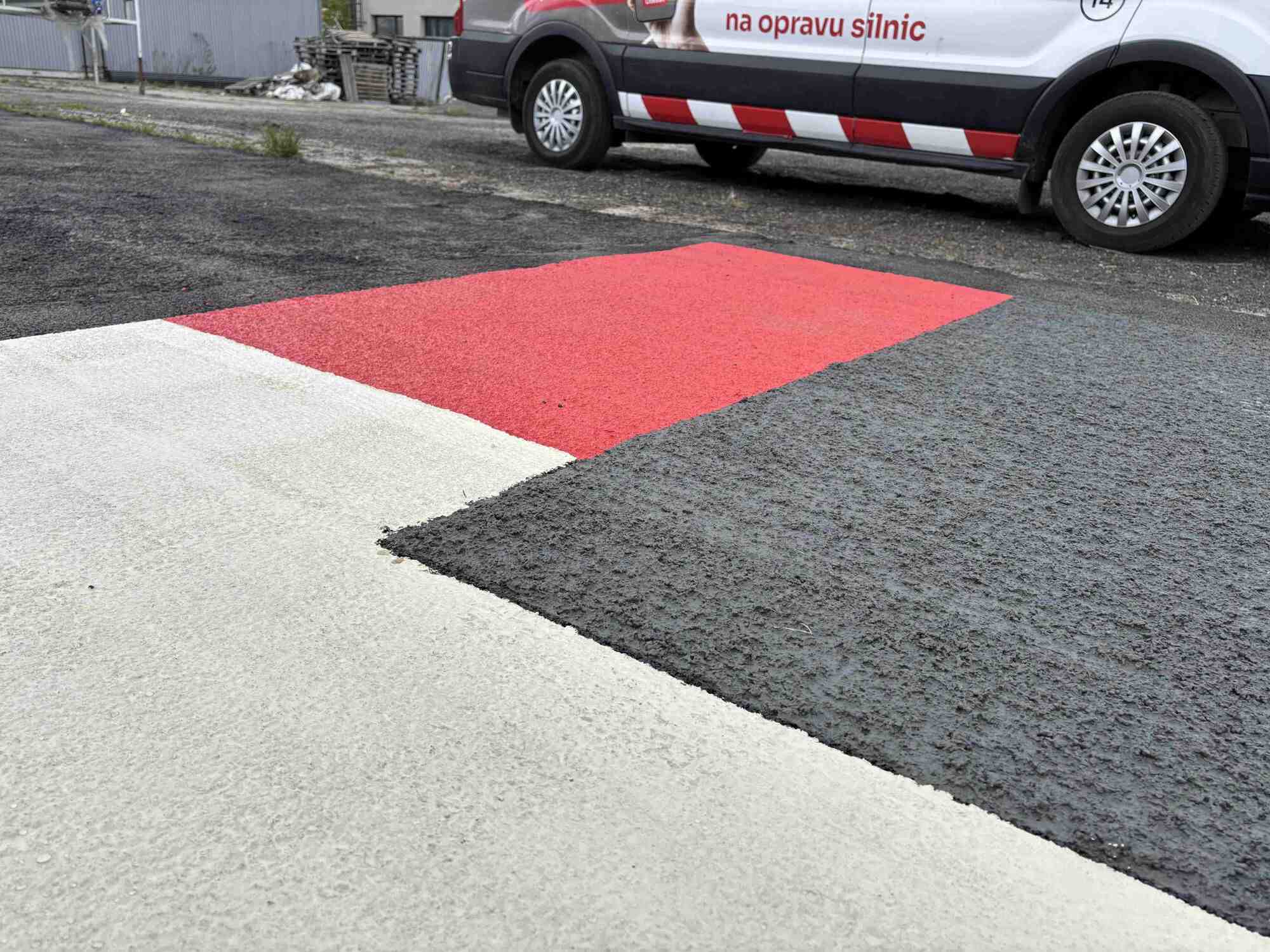
Type II is intended for applications where better visibility of markings is required, even in wet and rainy conditions. The structured design reduces the impact of a water film on retroreflection.
Yes. WeTraffic 497 is designed for Type II road marking applications and combines a structured anti-skid surface with visibility requirements.
Color highlighting can be used as an additional safety and visual element. However, it does not replace prescribed traffic signs, and the specific solution must comply with the rules for the given road.
Not automatically. The use of VBP is assessed based on the specific location, its traffic and safety conditions, and the relevant technical regulations.
A film of water can reduce the retroreflectivity of standard markings. Type II structured markings are designed to mitigate this effect and maintain better visibility even in wet conditions.


