
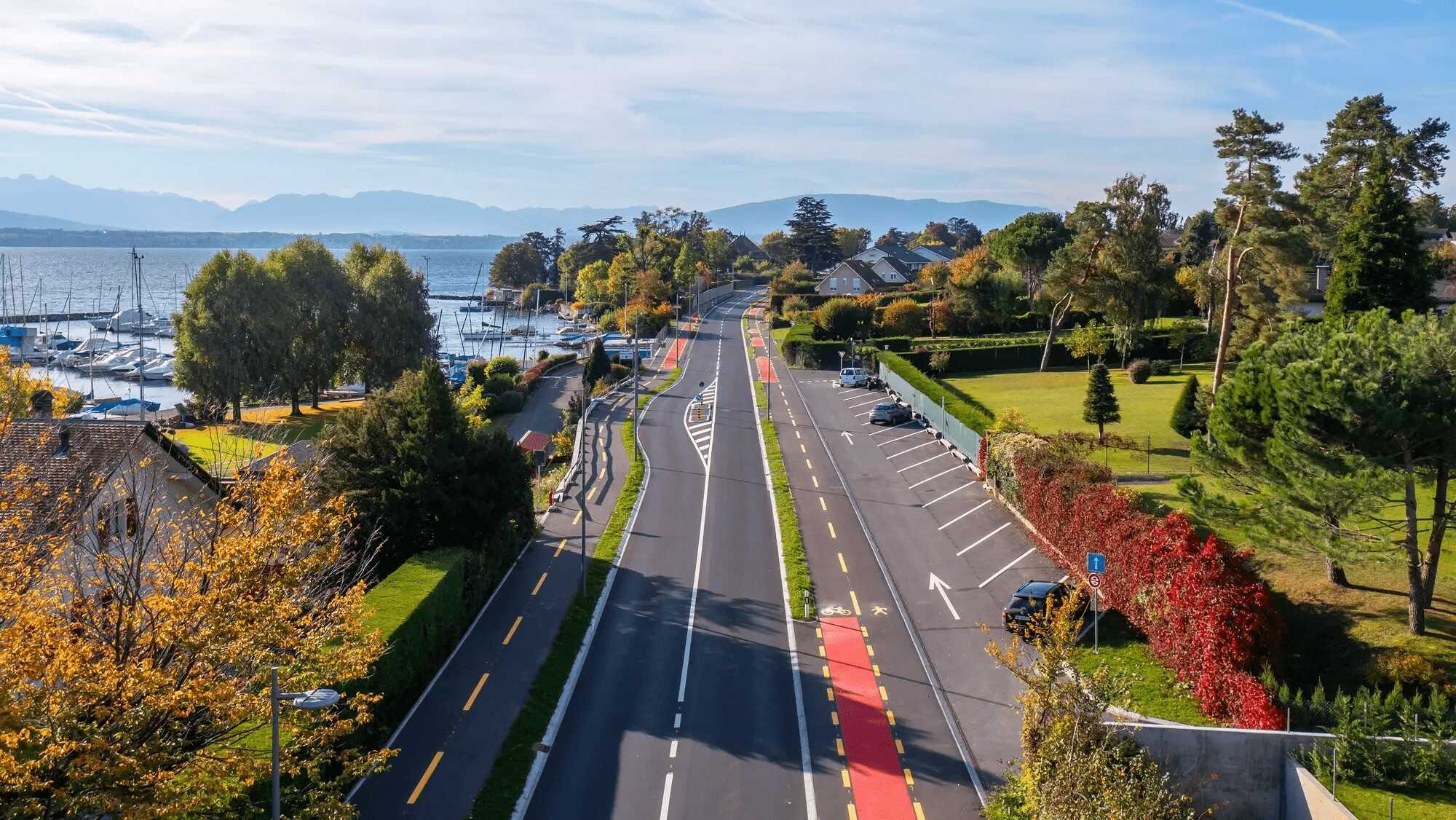
WeTraffic safety surfacing is an alternative to traditional colored asphalt paving in areas where high safety, long service life, and efficient installation are required. Unlike replacing the entire asphalt surface, WeTraffic technology can be applied to existing roads, reducing both the time and cost of the project.
Thanks to PMMA technology , WeTraffic offers not only color-coded surfaces but also adjustable anti-skid properties, high mechanical resistance, and long-term protection of the substrate.
Safety surfaces are therefore used, for example, at pedestrian crossings, bike paths, intersections, industrial sites, or other locations where it is important to increase traffic safety.
The main difference between WeTraffic and colored asphalt lies in the installation method, surface customization options, and overall functionality.
When applying the WeTraffic system, it is not necessary to remove the existing asphalt layer and lay a new surface.
By applying it directly to the prepared substrate, you can reduce:
Unlike colored asphalt, WeTraffic technology offers a wide range of color options based on the RAL color chart.
Color finishes allow you to:
The advantage of WeTraffic safety surfaces is the ability to tailor the final properties to specific conditions.
Depending on project requirements, you can adjust, for example:
This ensures that the result is not just an aesthetic element, but a functional part of the transport infrastructure.
One of the key elements for achieving high skid resistance WeTraffic systems is the use of mineral filler, such as natural bauxite.
Bauxite is a very hard mineral. Thanks to its structure, it helps create a surface with high skid resistance, which retains its properties even under heavy traffic loads.
This is particularly important in areas with frequent:
Unlike standard smooth surfaces, which can lose their texture over time, bauxite filler helps maintain the required level of anti-skid properties.
High surface roughness helps improve tire-to-road contact and contributes to increased safety, for example:
One of the main advantages WeTraffic technology is a more efficient way to utilize existing infrastructure.
Since the system is applied to the existing base, a complete reconstruction of the asphalt layer is not always necessary.
This means:
WeTraffic can also serve as a protective layer, helping to shield the asphalt from water, UV radiation, and other negative environmental factors.
Thanks to the rapid curing of PMMA technology, traffic disruption times can be significantly reduced.
This helps lower costs associated with, for example:
The price depends on the specific area, the condition of the base, and the required properties. The main advantage of WeTraffic is the ability to utilize existing infrastructure without a complete replacement of the asphalt surface, which can reduce overall project costs.
Most often in areas where safety and visibility need to be increased – for example at pedestrian crossings, cycle paths, intersections, parking lots, or industrial areas.
Bauxite aggregate increases surface roughness and helps maintain high anti-skid properties even under long-term operational loads.
The service life depends on the specific application, traffic intensity, and proper system design. Thanks to the durability of PMMA technology, however, it is a long-term solution for transport infrastructure.

