
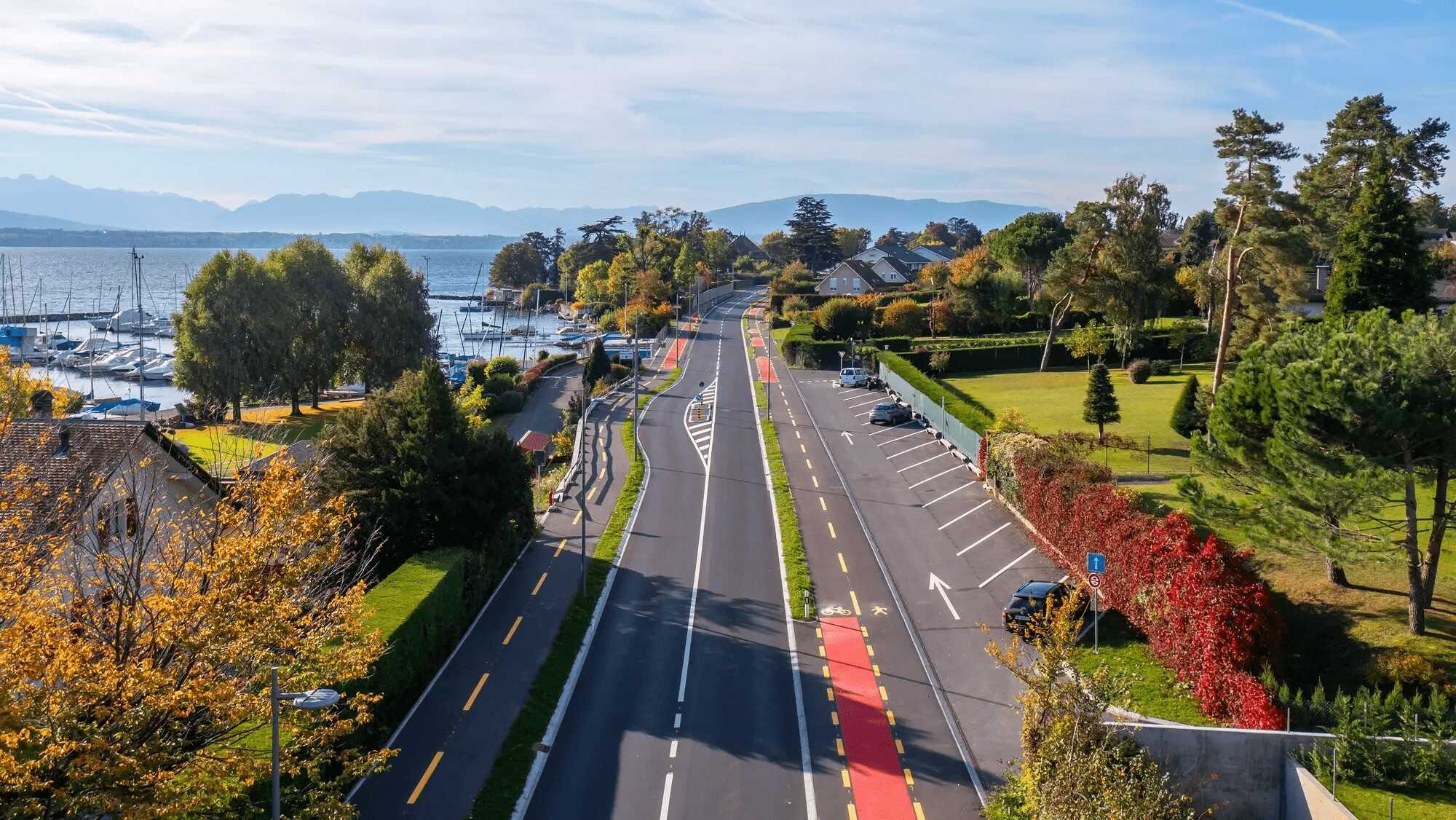
Modern traffic surfaces, horizontal road markings and safety surfaces must meet a range of technical requirements that ensure their visibility, safety, and long-term functionality.
In the Czech Republic, the design and implementation of these systems are based primarily on valid ČSN standards, technical conditions set by the Ministry of Transport, and requirements specified in the project documentation for each individual construction.
WeTraffic technology is designed to meet the demands of modern transport infrastructure and enables the creation of surfaces with high durability, visibility, and anti-skid properties.
One of the key documents for the field of horizontal road markings is the ČSN EN 1436standard, which defines the requirements for the functional properties of markings.
Monitored parameters include, in particular:
These parameters have a direct impact on driver safety, especially under poor lighting or weather conditions.
When implementing horizontal road markings, the technical specifications of the Ministry of Transport are also used in practice, for example:
These documents set out the requirements for proper execution, quality control, and the functional properties of the markings.
The classification into horizontal road markings of Type I and Type II relates primarily to the visibility of the markings under various weather conditions.
Type I represents standard smooth markings. Visibility may decrease during rain as water forms a continuous film on the surface, partially covering the reflective elements.
This can negatively affect driver orientation, especially at night or during heavy rainfall.
Type II utilizes a structured surface that ensures better visibility even in adverse weather conditions.
Thanks to the raised structure, water drains away more effectively, and the reflective elements remain more active even in the rain.
One of the advantages of PMMA technology is its high mechanical resistance. This leads to slower wear of the surface structure and longer retention of the required parameters.
You can find more about the properties of PMMA technology in the article PMMA Technology: What is it and why is it changing standards in transport construction?
Colored road highlighting is increasingly used as a tool to improve clarity and safety in high-risk areas.
For example, red areas in RAL 3020 shade can alert drivers to locations with increased pedestrian or cyclist traffic and act as a so-called optical psychological speed reducer.
A colored surface under a pedestrian crossing or in a high-risk area is not just an aesthetic feature. In practice, it is a high-friction safety surfacing, designed to improve traffic safety.
Specific solutions must always be based on the project documentation and the requirements of the given road.
WeTraffic technology allows for a wide range of color shades based on the RAL color chart. This enables safety features to be sensitively integrated into urban spaces, industrial areas, or public roads.
High-friction surface treatments are primarily used in areaswhere it is necessary to increase safety and improve adhesion between tires and the road surface.
Typical examples include:
To achieve high roughness, the system can PMMA be incorporated with a hard mineral filler, such as bauxite.
This filler increases friction between the tire and the surface, helping to improve vehicle safety, especially in critical situations.
Projects aimed at increasing traffic safety may, in certain cases, be eligible for grant programs that support road safety improvements.
Specific support options always depend on the current terms and conditions of individual grant schemes.
Key standards include, in particular, ČSN EN 1436, which sets out requirements for the functional properties of markings, such as visibility or skid resistance.
Type II uses a structured surface that provides better visibility in rain and adverse conditions than standard smooth Type I markings.
They help increase friction between the tire and the road, improve vehicle handling, and increase safety in high-risk road sections.

