
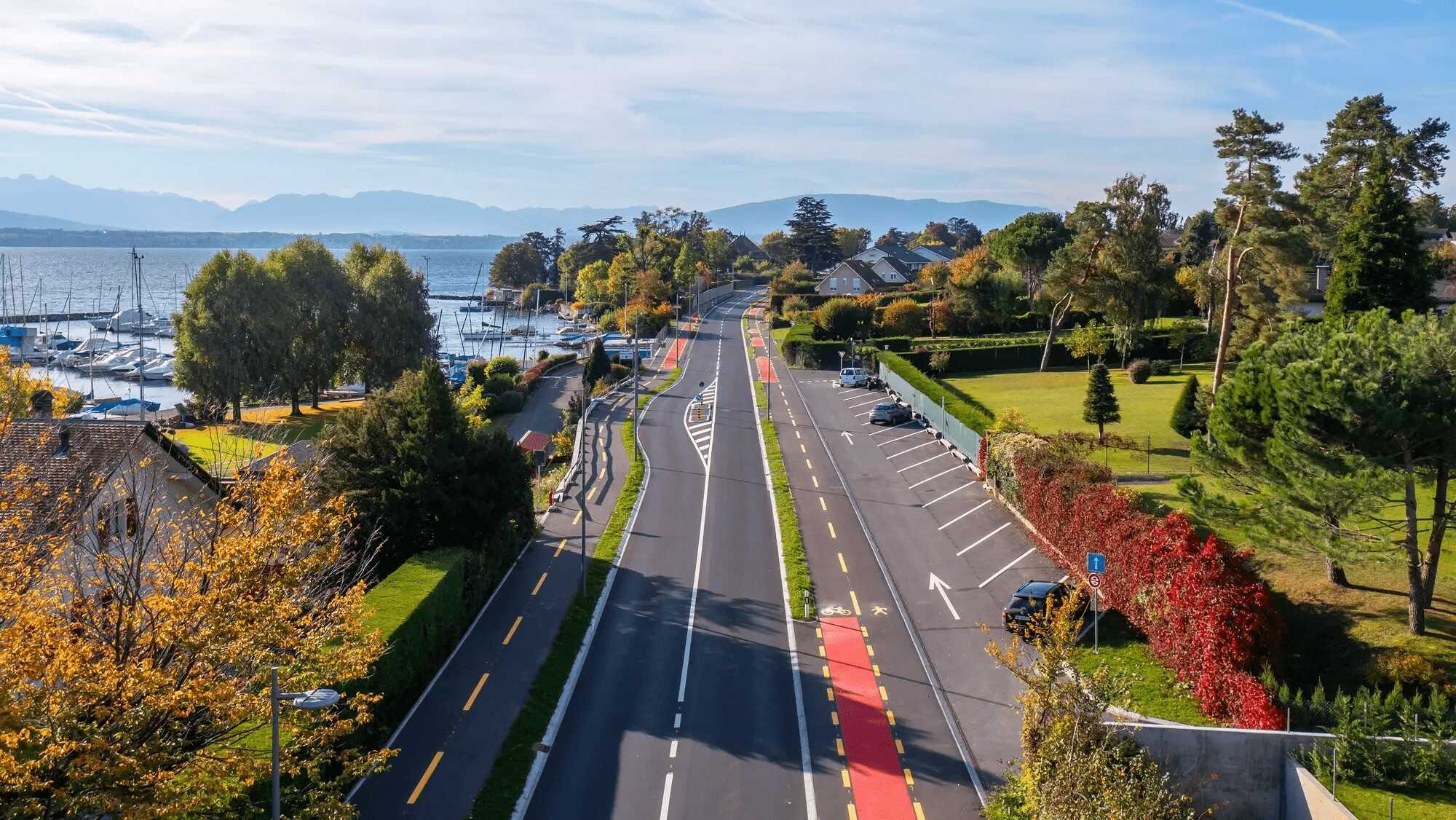
When restoring colored and safety surfaces, it is not always necessary to remove the existing asphalt and lay a new layer. If the substrate is in good technical condition, it can be restored using a thin-layer PMMA system WeTraffic, which is applied directly to the prepared asphalt or concrete surface.
The economic advantage lies not only in the cost of the material itself, but primarily in reducing the scope of construction work, shorter implementation time, and lower requirements for road restoration.
When completely replacing an asphalt surface, it is usually necessary to remove the existing layer, arrange for the transport and disposal of the milled material, and then lay a new asphalt carpet.
WeTraffic can, provided the substrate is in suitable condition, be applied directly onto existing asphalt or concrete. This eliminates the need for milling and the associated costs of heavy machinery, transport, and disposal of the original material.
It is not just about saving a single budget item. A smaller scope of construction work also means fewer logistical operations and less disruption to the existing road.
If the asphalt base is still structurally sound, replacing it entirely may be an unnecessarily extensive solution. In such cases, a thin-layer surface can be a way to restore the existing road and continue using it without a complete reconstruction.
Mechanically durable WeTraffic PMMA systems are designed for long-term loads and are also resistant to UV radiation and weather conditions.
A significant portion of the total reconstruction costs may not be the application itself, but rather traffic restrictions during implementation. Longer closures can lead to costs for traffic signage, detours, traffic management, and economic losses caused by restricted operations.
WeTraffic PMMA systems cure quickly and allow for short technological breaks. Depending on the specific system and conditions, the surface is ready for traffic in just a matter of minutes.
For suitable projects, the economic benefit of WeTraffic consists primarily of a combination of:
WeTraffic is therefore not just an alternative to colored asphalt in terms of appearance. Given a suitable base, it can represent a more efficient method of restoring colored and safety surfaces, which makes use of what is already present on the road.
Not necessarily. The final price depends on the condition of the base, the area, the required system, and the scope of preparatory work. The economic advantage arises primarily where it is not necessary to remove the existing asphalt and replace it with a new structural layer.
Depending on the specific solution, WeTraffic systems can be applied to both asphalt and concrete bases. The base must be technically suitable and properly prepared before application.
The curing speed depends on the specific system and the conditions of the project. WeTraffic technology is designed for rapid curing and minimal traffic disruption.
If a complete reconstruction is not necessary, it is possible to reduce the consumption of new materials, construction work, and the amount of waste generated. Economic savings can thus also be linked to more efficient use of existing infrastructure.

