
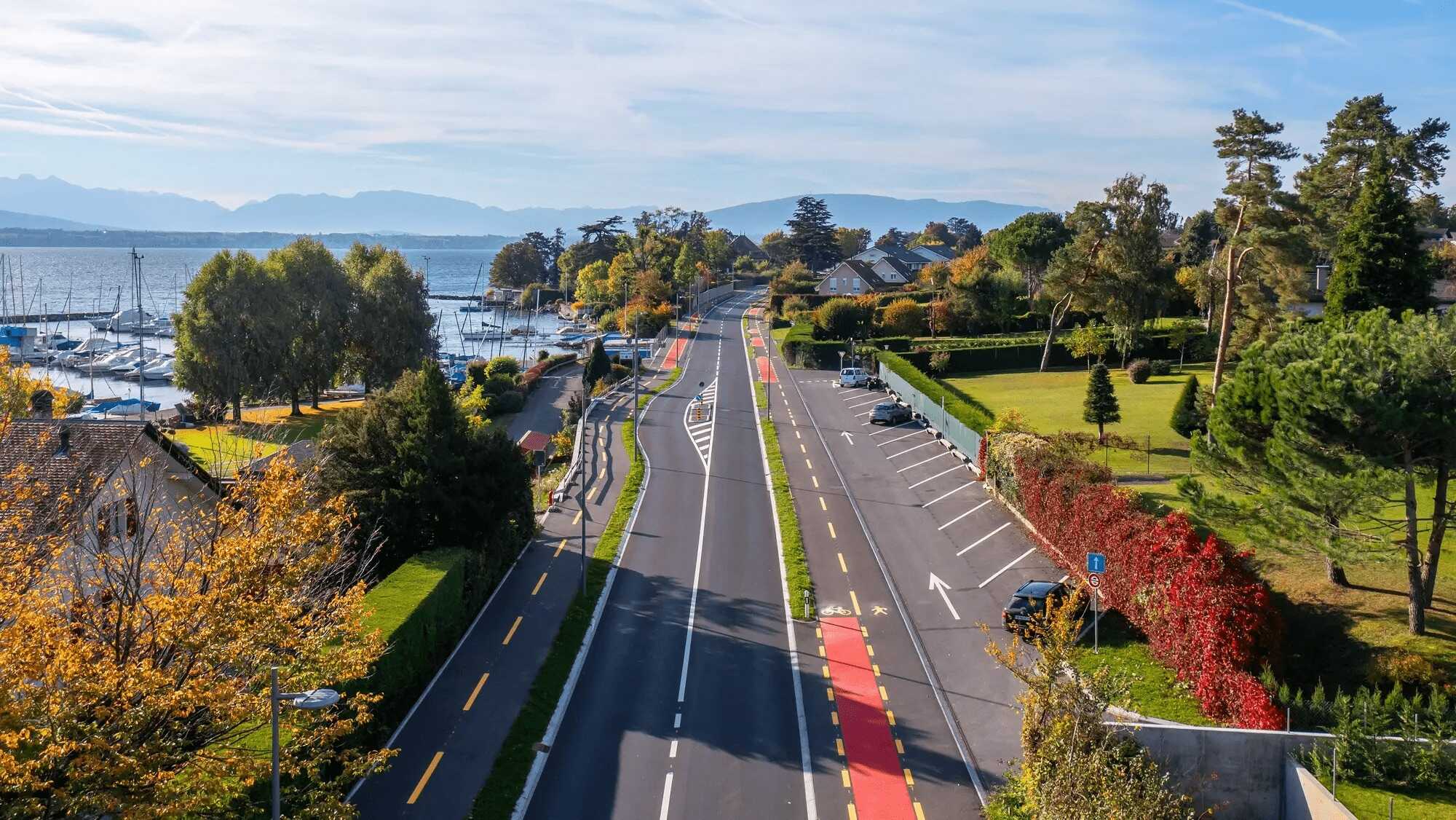
Beyond their aesthetic and safety functions, colored surfaces can also be a tool for managing the overheating of paved areas. The choice of color and surface properties, its durability, and how it is integrated into the overall public space design are all of significant importance.
Modern thin-layer PMMA-based surfaces allow for the renovation of existing asphalt and concrete areas, changing their color while simultaneously adding functional properties. The WeTraffic technology is designed for roads, cycle paths, sidewalks, and other public spaces.
Dark asphalt surfaces absorb a significant portion of solar radiation and can heat up considerably during the summer months. A large number of dark, impermeable surfaces therefore contributes to the urban heat islandeffect, where built-up urban areas are warmer than the surrounding undeveloped land.
One possible measure is the use of appropriately selected surface materials and colors. Lighter shades generally reflect more solar radiation than dark surfaces, and can thus help reduce surface temperatures.
However, colored surfaces should not be viewed as a standalone solution for urbanoverheating. The greatest effect can be achieved by combining them with other adaptation measures, such as greenery, shading, or water features.
In addition to its visual function, a colored surface can also serve a protective purpose. If the existing asphalt base is in sufficiently good technical condition, it is not always necessary to completely remove it and replace it with a new asphalt layer during renovation.
Thin-layer PMMA system WeTraffic can be applied to a suitably prepared asphalt or concrete surface. It creates a durable surface layer that helps protect the substrate from the effects of UV radiation, weather conditions, and mechanical stress.
Extending the service life of existing asphalt can also mean less need for extensive repairs and reconstruction. If there is no need to mill and completely replace the substrate, the amount of excavated material and the consumption of new construction materials are simultaneously reduced.
Surface color has more than just an aesthetic purpose in public spaces. It also helps to visually distinguish between different area functions and improve clarity.
Colored surfaces can be used, for example, for:
WeTraffic technology allows for the selection of color shades according to the RAL color chart. Designers or architects can thus adapt the color scheme to the character of a specific location while also utilizing contrast where clear user orientation is essential.
A colored surface can therefore combine aesthetic, navigational, and safety functions.
The environmental friendliness of individual technologies must be assessed over their entire life cycle. It is not just about the composition of the material itself, but also the amount of material used, the application method, the durability of the surface, and the extent of future repairs.
For thin-layer PMMA systems, a significant benefit can be, above all, the ability to restore a suitable existing substrate without completely removing it. In specific projects, this can reduce milling, the amount of construction waste, the need for new asphalt mixtures, and the volume of material transport.
WeTraffic is a two-component PMMA-based system that is free of solvents and plasticizers and is designed for long-lasting, durable surface finishes. Its service life and the possibility of restoring existing surfaces can be important factors when seeking more material-efficient and operationally sustainable solutions.
However, an ecological approach does not mean choosing just one material. What is most important is a combination of long service life, minimal unnecessary construction work, and thoughtful public space design.
Modern public spaces must address multiple requirements simultaneously—safety, navigation, aesthetics, durability , and the impacts of climate change.
Colored surfaces can be a tool to integrate these requirements. They help distinguish between different types of traffic, highlight high-risk areas, visually unify public spaces, and, when the right shade is chosen, help reduce the overheating of paved surfaces.
WeTraffic combines this principle with a durable, thin-layer PMMA systemthat can be applied to both asphalt and concrete substrates and color-customized for specific projects.
The result is not just a colored area, but a functional part of the public space that accounts for safety, aesthetics, durability, and environmental context.
Yes, appropriately chosen lighter surfaces can reflect more sunlight and have a lower surface temperature than dark asphalt. However, changing the surface alone is not a solution to the urban heat island effect; it works best in combination with greenery, shading, and other adaptation measures.
Thin-layer surface systems can protect suitable existing substrates from UV radiation, weather, and mechanical stress. This helps extend their service life and delay the need for major reconstruction.
WeTraffic allows you to choose a color shade from the RAL color chart. The color can be adapted to the local architecture, the function of a specific area, and requirements for visual differentiation.
Yes. Colored surfaces can be used to visually distinguish areas designated for cyclists and improve their clarity. For systems with appropriate anti-skid properties, surface safety can also be addressed simultaneously.
The environmental impact must always be evaluated in the context of a specific project and its entire life cycle. The benefits of PMMA systems include the ability to restore suitable existing substrates without complete replacement, long service life, and a reduction in the scope of construction work. At the same time, WeTraffic is a solvent-free and plasticizer-free system.
Yes, provided the existing substrate is technically suitable for such an application and properly prepared. Thin-layer systems can thus serve as an alternative to certain types of more extensive reconstruction.